
News
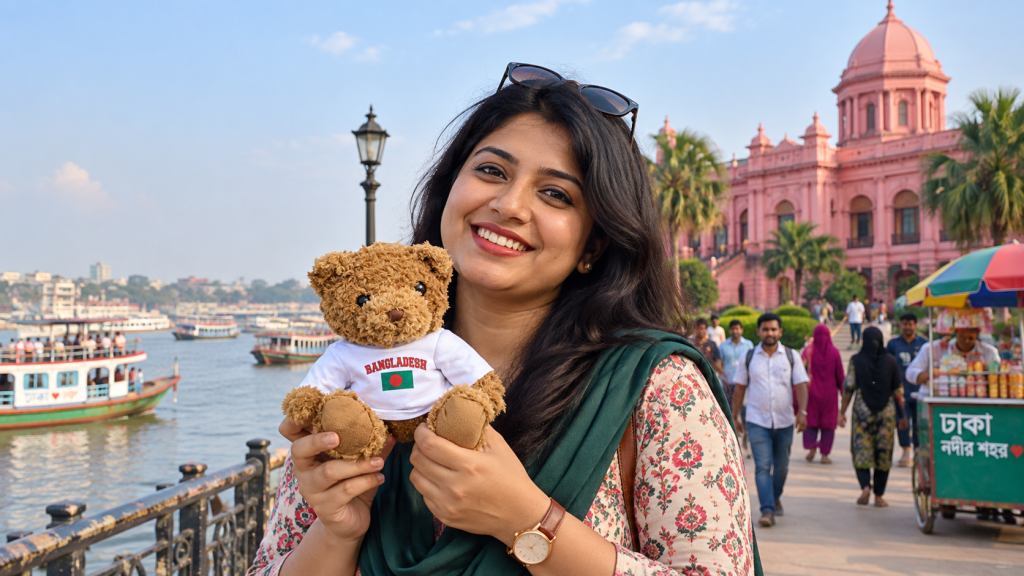
A Bangladesh Adventure with a Little Flag Teddy Bear
Sep
Bangladesh is a country made for curious travellers. Its cities pulse with colour, its rivers shape daily life, and its green landscapes seem to stretch forever. On this journey, our pocket-sized companion is the Bangladesh Flag Teddy Bear a cuddly 20 cm souvenir wearing the country’s red-and-green flag with pride.
Small enough to fit into hand luggage yet full of personality, the bear joins us for six very different stops. Together they reveal Bangladesh as a land of grand palaces, centuries-old trading towns, orderly tea terraces, a vast golden coastline, mysterious mangrove creeks and one of South Asia’s most remarkable archaeological sites.
1. A colourful welcome beside Ahsan Manzil in Dhaka

Dhaka does not ease visitors in quietly. Rickshaws flash past in a whirl of painted panels, food stalls send wonderful aromas into the streets, and the Buriganga River carries boats of seemingly every size. At its historic heart stands Ahsan Manzil, instantly recognisable by its rich pink exterior and central dome.
Once the residential palace of Dhaka’s nawabs, the building now serves as a museum. It gives visitors a glimpse into the lives of an influential family and the city that grew around them. From the grounds, our bear can watch ferries and wooden boats crossing the water while the busy capital continues all around. The official Bangladesh High Commission tourism guide offers a useful introduction to Ahsan Manzil and other major sights.
Old Dhaka rewards unhurried exploration, but its energy, heat and traffic can be intense. Dress modestly, carry drinking water and allow far more time than the map suggests. A local guide can add invaluable context and help first-time visitors navigate the historic lanes.
2. Stepping back in time at Sonargaon

Roughly 27 kilometres south-east of Dhaka lies Sonargaon, an area that once held great importance as a political and commercial centre. Its most atmospheric corner is Panam Nagar, where a narrow street is lined with timeworn merchant houses. Their arches, balconies and ornamental details hint at former prosperity, while exposed brick and creeping plants give the town a haunting beauty.
The little Bangladesh bear looks perfectly at home against this warm brickwork. Panam Nagar is compact enough to explore slowly, noticing the differences between neighbouring façades rather than simply rushing from one end to the other. Visitors should respect barriers and avoid climbing on fragile structures. Combining Panam Nagar with Sonargaon’s other museums and heritage sites makes a rewarding excursion from Dhaka.
3. Green horizons in Srimangal’s tea country

After the capital’s constant movement, Srimangal feels wonderfully restorative. Often described as Bangladesh’s tea capital, this north-eastern region is known for rolling estates, forest, wetlands and a slower pace. Rows of glossy tea bushes curve across the land in neat green patterns, particularly beautiful in the softer light of morning.
This is not merely scenery: the gardens are working landscapes. Visit responsibly, stay on permitted paths, and ask before photographing workers. Nearby Lawachara National Park introduces another shade of green, with semi-evergreen forest, walking trails and rich biodiversity. Wildlife sightings can never be guaranteed, which is precisely why quiet, patient exploration matters.
Srimangal is also famous for layered tea, served so that differently coloured bands appear in one glass. It makes a cheerful reward after a warm walk. Our teddy, safely held above the leaves, adds an unmistakable splash of Bangladesh red and green to the view.
4. Sunset on Cox’s Bazar beach

Cox’s Bazar brings a complete change of mood. Here the shore meets the Bay of Bengal in a long sweep of sand, drawing families, fishermen and holidaymakers. Late afternoon is especially appealing, when the temperature softens and the setting sun lays a golden path across the water.
The beachfront can be lively, but there is space to pause, watch fishing boats and enjoy the sea air. Keep the bear away from salt water and wind-blown sand, then take a few photographs while it sits securely in an adult hand. Travel farther along the coast and the atmosphere changes again, with quieter stretches around Himchari and Inani.
Sea conditions deserve respect. Follow current local warnings, swim only where advised, and check transport and weather information before travelling. Bangladesh’s High Commission notes Cox’s Bazar among the country’s best-known visitor destinations, while also offering wider background on its coastal attractions.
5. Following the waterways of the Sundarbans
