
News
A Teddy Bear’s Unforgettable Adventure Across South Africa
Sep
South Africa is the sort of country that makes a small travelling companion feel wonderfully ambitious. One moment our 20 cm teddy bear is peering across Cape Town from a mountain ledge; the next, he is meeting penguins beside the Atlantic, following the road into the Winelands or watching elephants cross the Lowveld. It is a journey filled with enormous landscapes, layered history and warm human moments—and our little South Africa Forever! teddy bear is ready for every mile.
This six-stop adventure deliberately mixes famous sights with places that reveal the country’s character. It is not a rushed checklist. Instead, it gives our bear time to absorb the view, meet local wildlife responsibly and understand some of the stories that shaped modern South Africa.
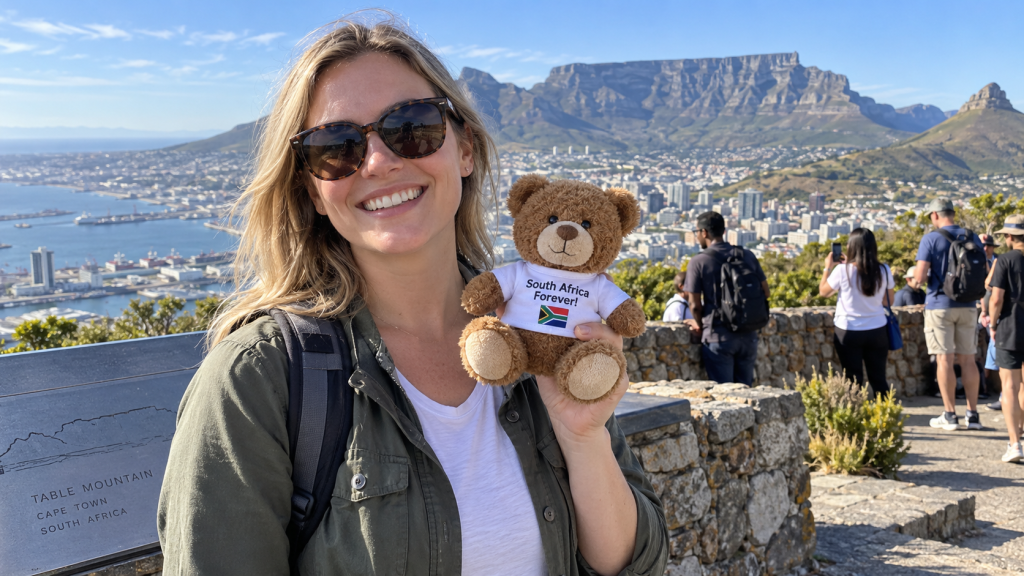
1. Looking Down on Cape Town from Table Mountain
The journey begins where Cape Town seems to arrange itself between mountain and sea. Table Mountain’s broad, level summit dominates the city, while Table Bay, Lion’s Head and the peninsula create an extraordinary panorama. On a clear morning, even a teddy bear can appear contemplative when faced with so much space.
Visitors can reach the upper station by cableway or choose one of several walking routes suited to different levels of experience. Mountain weather changes quickly, so sensible layers, water and a check of current conditions are essential. Once at the top, the marked paths and viewpoints reveal how closely the city is tied to the natural world. The wider national park extends along the peninsula and protects remarkable plant life within the Cape Floristic Region.

Our bear sits beside an ordinary daypack, making his real 20 cm height easy to appreciate. Around him, some travellers pause for photographs while others continue along the path. For current access and conservation information, consult Table Mountain National Park.
2. Meeting the Penguins at Boulders Beach
South of central Cape Town, Boulders Beach offers one of the trip’s most charming wildlife encounters. African penguins gather among pale granite rocks, sheltered coves and clear water near Simon’s Town. The boardwalks allow visitors to observe the colony without wandering into sensitive nesting areas.
These birds may look comical as they waddle, but they are endangered wild animals rather than performers. Keeping to the paths, giving them space and following ranger instructions helps protect the colony. The visit is especially memorable in the gentler light of morning, before the busiest part of the day.

Held comfortably in one hand, our teddy is correctly proportioned against the visitor and wooden rail. Behind him, people arrive, leave and stop to watch the penguins, creating the easy movement of a genuine coastal attraction. Practical visitor guidance is available from Cape Town Tourism’s Boulders Beach guide.
3. A Slow Afternoon in the Cape Winelands
From Cape Town, the scenery changes as the road moves into the Cape Winelands. Stellenbosch and nearby Franschhoek are framed by serrated mountains, vineyards and distinctive Cape Dutch architecture. Although the region is internationally known for wine, its appeal is broader: historic streets, galleries, gardens, cafés, farm shops and mountain views give non-drinkers plenty to enjoy.
Our bear chooses a sunny café table, settling beside a normal-sized coffee cup that once again keeps his 20 cm scale completely believable. The late-afternoon light warms the white gables, and visitors wander between the gardens and terraces without the background feeling staged.

A day here is best enjoyed slowly. Leave room for a walk through Stellenbosch’s oak-lined centre, a leisurely meal and time to admire the mountain setting. If visiting estates, arrange transport rather than driving after tastings, and remember that many properties require advance reservations during busy periods.
4. Listening to Johannesburg’s Story at Constitution Hill
The adventure then turns inland to Johannesburg, a city whose energy and history deserve time and attention. Constitution Hill occupies a former prison complex and is now also home to South Africa’s Constitutional Court. Its buildings connect painful accounts of confinement and injustice with the continuing ideals of human rights and democracy.
This is not a place to hurry through merely for photographs. Exhibitions and guided experiences help visitors understand the Old Fort, the Women’s Gaol and Number Four prison, where people were held under harsh and discriminatory systems. The site invites reflection on how a country remembers oppression while building a constitutional future.

Our small companion is held respectfully as visitors read displays, join tours and cross the courtyard in different directions. It feels like a real public space rather than an empty backdrop. Travellers should use official guidance, allow several hours and approach the stories here with care.
5. Following the Panorama Route to Blyde River Canyon
East of Johannesburg, the Panorama Route introduces another South Africa: forested escarpments, waterfalls and vast geological formations. Blyde River Canyon is the dramatic centrepiece, with viewpoints opening over green cliffs and the rounded peaks known as the Three Rondavels.
The scale of the landscape can be difficult to grasp until a folded trail map and our small teddy are placed in the foreground. Beyond them, layers of rock and vegetation roll towards the horizon. Hikers arrive at the rail, others turn back towards the path and a few simply stand quietly, letting the view do all the talking.

Allow time for several viewpoints rather than attempting to see the route through a car window. Footwear with grip is useful, mist can reduce visibility and edges demand caution. Starting early provides softer light and makes the drive more relaxed before continuing towards the Lowveld.
6. A Responsible Safari in Kruger National Park
The final stop is Kruger National Park, one of Africa’s great protected wildlife areas. Dawn arrives in muted gold as the safari vehicle follows a road between grassland, riverine woodland and bush. The reward is never guaranteed—and that uncertainty is part of the experience. A distant herd of elephants becomes far more meaningful when encountered on its own terms.
Our bear remains securely inside the vehicle and fits naturally in one adult hand. Nobody calls to the animals, leans out or tries to draw them closer. Instead, passengers watch quietly, allowing the elephants to choose their own route and distance.

Responsible safari habits matter: stay inside vehicles where required, obey speed limits, never feed wildlife and keep noise low. Binoculars make distant sightings more rewarding without disturbing animals. Check gates, accommodation and conservation guidance directly through SANParks’ official Kruger National Park information.
A Small Bear in a Vast and Varied Country
South Africa’s contrasts make this journey unforgettable. Table Mountain offers ocean and city in a single glance; Boulders Beach brings an endangered penguin colony within respectful viewing distance; the Winelands slow the pace; Johannesburg asks important questions; Blyde River Canyon expands the horizon; and Kruger returns attention to the rhythms of wild animals.
Through it all, the 20 cm South Africa teddy bear remains a cheerful travelling thread—small enough to hold comfortably, distinctive enough to bring personality to every photograph and ready to become a keepsake of a remarkable country. The South Africa Forever! teddy bear makes a thoughtful companion for someone planning the journey, remembering home or celebrating a special connection with South Africa.
