
News
10 Best Places to Visit in Madrid with a Teddy Bear
Sep
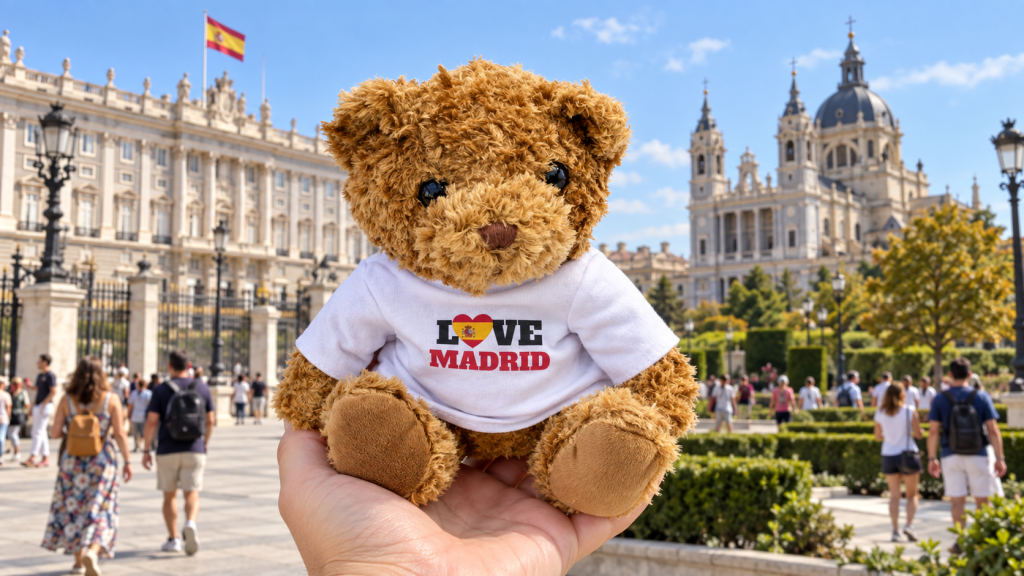
Madrid has a talent for making every arrival feel like the beginning of a celebration. Our little I Love Madrid teddy packed remarkably lightly—being only 20 centimetres tall has its advantages—and set off to explore the Spanish capital’s grand squares, royal architecture, leafy parks and world-famous art. With a comfortable seat in a traveller’s hand and his Madrid shirt looking splendid, he was ready for ten memorable stops.
This is a city best enjoyed with curiosity rather than haste. Historic lanes open into monumental plazas, elegant boulevards lead towards remarkable museums, and even an ancient Egyptian temple has found a home beneath the Castilian sky. Here is our teddy-sized tour of Madrid, combining practical inspiration with plenty of time to pause, look around and enjoy the atmosphere.
1. Plaza Mayor: A Grand First Paw-print

Plaza Mayor is an irresistible place to begin. Enclosed by warm red façades and graceful arcades, the square sits at the heart of Habsburg Madrid. Its orderly appearance hides a wonderfully eventful past: the site developed from the old Plaza del Arrabal market, while the monumental square took shape under Philip III. His equestrian statue, completed in 1616 and moved here in 1848, now watches over the activity below.
Our teddy was especially taken with the Casa de la Panadería and its decorated façade. The building began as Madrid’s principal bakery, but has served several purposes over the centuries and now houses a tourist information centre. Another feature worth finding is the Arco de Cuchilleros, the best-known of the nine entrances created during Juan de Villanueva’s reconstruction after the devastating fire of 1790. The steep steps and surrounding lanes are excellent for an unhurried wander. Read more on the official Madrid tourism page for Plaza Mayor.
The square can be busy, but that is part of its charm. Arrive earlier in the morning for quieter photographs, then stay to watch Madrid wake up around you. Teddy’s verdict was that the arcades provide excellent shade and the people-watching is first class.
2. The Royal Palace of Madrid: Rooms Fit for a Very Small Guest

The Royal Palace makes a magnificent second stop. Its immense pale-stone exterior dominates the western side of central Madrid, and the ceremonial setting around Plaza de la Armería gives even the smallest visitor a sense of occasion. The palace contains more than 3,000 rooms, although public visits follow a carefully selected route through lavish state apartments and important collections.
Inside, visitors can encounter royal decoration, historic furnishings and works associated with celebrated artists including Goya, Velázquez and Caravaggio. The Royal Armoury is another highlight for anyone interested in craftsmanship and courtly history. Our teddy sensibly remained an outdoor tourist for his photograph—palace rules do not permit selfie sticks, and a bear should never cause a constitutional incident.
Opening arrangements can change for official events, so check the official Royal Palace visitor and ticket information before travelling. The site advises that a self-guided visit to the halls takes approximately 45 minutes, with additional time needed for the Royal Armoury. The palace is accessible to visitors with reduced mobility, and wheelchairs are available.
3. El Retiro Park: A Green Afternoon in the Capital

After royal splendour, El Retiro offers space to breathe. This much-loved park has almost four centuries of history and is both a cultural landscape and an important green refuge in the centre of Madrid. Its avenues, gardens, fountains and monuments reward aimless strolling, while the lake beside the Monument to Alfonso XII creates one of the city’s most familiar scenes.
The boating lake supplied our teddy with a fine backdrop, although he wisely stayed on dry land. Nearby, the grand colonnade curves around the equestrian monument and provides an impressive sense of scale. Elsewhere in the park, visitors can seek out the Crystal Palace, formal gardens and shaded paths where the city feels pleasantly distant.
El Retiro is not merely decorative. Madrid City Council describes it as a “garden of gardens”, reflecting changing styles and tastes, as well as an ecological island rich in plants and wildlife. The park forms part of the UNESCO-listed Paseo del Prado and Buen Retiro landscape. For official information and guided activities, consult Madrid City Council’s El Retiro information.
4. Museo Nacional del Prado: Masterpieces and Quiet Wonder

No art-loving tour of Madrid would be complete without the Prado. The museum’s collection offers an extraordinary journey through European painting, with particular strength in Spanish masters. Velázquez, Goya and El Greco are central figures, while works by Rubens, Titian, Bosch and many others make it easy to lose track of time.
Our teddy posed outside the Villanueva Building near the statue of Velázquez, looking suitably thoughtful. Inside, a sensible plan is more useful than an attempt to see everything. Choose a selection of masterpieces, leave time to look properly, and accept that a return visit may be necessary. Even the most energetic bear has limits to his cultural concentration.
The museum recommends buying tickets online to avoid waiting. It also provides maps, audio guides, accessible facilities, rest areas and places for refreshments. Current opening hours, admission conditions, exhibitions and visitor rules are published on the official Museo Nacional del Prado visitor page. Check these details shortly before your visit, as exhibitions and arrangements naturally change.
5. Gran Vía: Madrid in Full Colour

Gran Vía brings a different energy. Cutting through central Madrid, the avenue is lined with exuberant early twentieth-century architecture, theatres, cinemas, hotels and shops. Look above street level and the rooftops become a parade of domes, sculptures and decorative flourishes. The Metropolis Building, crowned by a winged figure, is among the avenue’s most recognisable landmarks.
This is a place to enjoy on foot, while remembering that it remains a busy city thoroughfare. Broad pavements and pedestrian areas make it easier to appreciate the buildings, but crossings should be approached with ordinary care. Our teddy remained safely supported and discovered that being carried is an excellent way to admire architecture without wearing out one’s paws.
Gran Vía is particularly atmospheric as daylight begins to soften and the city lights appear. From here, it is easy to continue towards Plaza de España, Callao or the streets around Puerta del Sol. The official Madrid tourism website provides current ideas for exploring the Sol and Gran Vía area, public transport guidance and seasonal events.
6. Temple of Debod: A Madrid Sunset with an Egyptian Story

Madrid saves one of its most surprising sights for the western side of the centre. The Temple of Debod is an ancient Egyptian monument whose origins reach back to the second century BC. Egypt gave the temple to Spain in gratitude for Spanish assistance with the international effort to save Nubian monuments threatened by the Aswan Dam. It was dismantled, transported and reconstructed in Madrid, opening here in 1972.
The surrounding gardens are an excellent sunset location, with views towards the Manzanares valley, Casa de Campo and the Royal Palace area. Reflections and warm evening light can create a memorable scene, but this is a popular time to visit, so patience and considerate positioning are essential. Teddy was delighted to discover that a 2,000-year-old monument can still upstage almost any holiday photograph.
Entry is free, although advance reservation is recommended for the interior. Capacity is limited and temporary closures may occur for conservation or security reasons. Check current hours and access information on the official Temple of Debod tourism page before setting out.
7. Puerta del Sol: The Heart of Madrid

Puerta del Sol feels like the point where Madrid’s many stories meet. The broad, semicircular square connects some of the centre’s best-known streets and marks Kilometre Zero, the point from which Spain’s principal radial roads are measured. It began near one of the old city gates, but today it is a meeting place, transport hub and essential stop for first-time visitors.
The clock above the Casa de Correos is nationally famous. On New Year’s Eve, crowds gather here while people across Spain follow the tradition of eating twelve lucky grapes with the twelve midnight chimes. The square also contains the equestrian statue of Charles III and the much-loved Bear and Strawberry Tree sculpture—the official symbol of Madrid and, naturally, a landmark that earned enthusiastic approval from our own small bear.
Pause long enough to find the Kilometre Zero plaque, admire the restored open space and watch Madrileños pass through one of their city’s liveliest crossroads. The square is busiest around major celebrations, so visitors seeking relaxed photographs may prefer the morning. Learn about its monuments and transport connections through the official Puerta del Sol tourism page.
8. Cibeles Palace and Fountain: Madrid at Its Most Magnificent

Plaza de Cibeles presents one of Madrid’s finest urban views. At its centre, the celebrated fountain depicts the goddess Cybele in a chariot pulled by lions. Behind it rises Cibeles Palace, an elaborate white landmark originally created as the headquarters of Spain’s Post Office. Designed by Antonio Palacios and Joaquín Otamendi, the building opened in 1909 and has housed Madrid City Council since 2007.
The palace is more than an impressive exterior. Its public spaces include CentroCentro, which presents contemporary cultural programmes, the glass-roofed Galería de Cristal and the Landscape of Light Interpretation Centre. The building itself can be entered free of charge, although particular exhibitions or experiences may have separate arrangements. Teddy considered applying for a position at City Hall but decided that sightseeing involved fewer meetings.
Take care when photographing the fountain because the plaza is surrounded by busy roads; use proper pedestrian areas and crossings rather than stepping into traffic for a better angle. Visitor facilities, accessibility information and current opening arrangements are listed on the official Cibeles Palace tourism page.
9. Museo Reina Sofía: Modern Art with a Powerful Voice

Where the Prado explores many earlier chapters of European art, Museo Reina Sofía brings the story forward into the twentieth century and beyond. Its collection is particularly important for Spanish modern art. Pablo Picasso’s monumental Guernica is the best-known work, presented within a wider historical and artistic context that rewards thoughtful viewing rather than a hurried dash to one famous canvas.
The main museum occupies the Sabatini Building, a former hospital transformed into a cultural landmark and now distinguished by glass lift towers on its exterior. The Nouvel extension adds further galleries and public spaces. The museum recommends allowing around two hours for an individual visit, while quieter conditions are often found during the afternoon rather than the busiest morning period.
Visitors can use either the Sabatini entrance or the Nouvel Building courtyard entrance, with the latter recommended for people who already hold online tickets. The museum closes on Tuesdays, and operating details can change, so consult the official Museo Reina Sofía visitor information. Teddy remained outside for his photograph and promised not to offer unsolicited art criticism.
10. Santiago Bernabéu Stadium: A Sporting Madrid Landmark

Madrid’s cultural identity also includes football, and the Santiago Bernabéu is one of the sport’s most recognisable venues. Home to Real Madrid since 1947, the stadium has undergone a dramatic twenty-first-century transformation, giving its exterior a sweeping metallic appearance that looks striking from the surrounding streets.
The official stadium tour normally includes the Real Madrid museum, a panoramic interior view and areas connected with match-day life, although the precise route varies around fixtures, concerts and other events. On match days, access ends well before kick-off, and dressing rooms or dugouts may be unavailable during preparations. That makes advance planning important even for visitors whose teddy is already wearing the right city name.
The Bernabéu lies north of Madrid’s historic centre and is easily reached by Metro. Allow extra time around events, when the surrounding area becomes considerably busier. Current tour routes, operating notices and booking details appear on the official Tour Bernabéu website. Even non-football supporters may enjoy seeing how a famous stadium has been reinvented on such an ambitious scale.
A Capital Made for Curious Travellers
From Plaza Mayor’s arcades to El Retiro’s green calm, Madrid balances ceremony, culture and everyday life with tremendous confidence. These ten stops provide a rewarding first introduction, but the pleasure lies just as much in the connections between them: a tiled street sign, a sunny café terrace, an unexpected view or the sound of conversation drifting across a square.
Our teddy finished his adventure with a full camera roll, a new appreciation of Spanish art and absolutely no complaints about being carried. Plan realistically, check official visitor information, use Madrid’s excellent public transport when needed and leave some room for spontaneous discoveries. The capital rarely reveals all its charms in one visit—and that is an excellent reason to return.
Take Home Your Own Charming I Love Madrid Teddy Bear
Keep the warmth of Madrid close with the adorable Love Madrid Spain Flag Heart Teddy Bear Funny Souvenir Gift Present. This charming, cuddly bear makes a memorable souvenir, a cheerful travel companion or a wonderful present for somebody who loves Madrid. Visit the exact product page today and get your own matching Madrid teddy ready for its next adventure.
